Streamlined Council Approvals
Avoid costly DA delays with professional reports that meet Rockhampton Regional Council criteria on first submission.
Comprehensive AQF Level 5 consulting arborist assessments, development reports, and tree risk evaluations in Port Curtis
Delivering consulting arborist reports across Port Curtis, Depot Hill, and Central Queensland.
When planning construction, subdividing land, or navigating council planning overlays, an arborist report Port Curtis is the formal standard required for decision-making. Our AQF Level 5 arborists deliver rigorous, evidence-based reports.
Port Curtis includes commercial holdings, semi-rural lots, and sensitive flood plain ecosystems near the Fitzroy River. Development applications here frequently trigger the Biodiversity areas overlay on RockePlan. Our Level 5 reports clearly define significant native trees versus environmental weed species like Leucaena and African Tulip, expediting council approval pathways.
Avoid costly DA delays with professional reports that meet Rockhampton Regional Council criteria on first submission.
Obtain written, legally defensible documentation of tree risk to satisfy insurers, landlords, and neighbours.
Protect valuable mature shade trees during earthworks using precise AS4970 tree protection zone calculations.
We review your site plans, council requests, and relevant RockePlan overlays for your Port Curtis block.
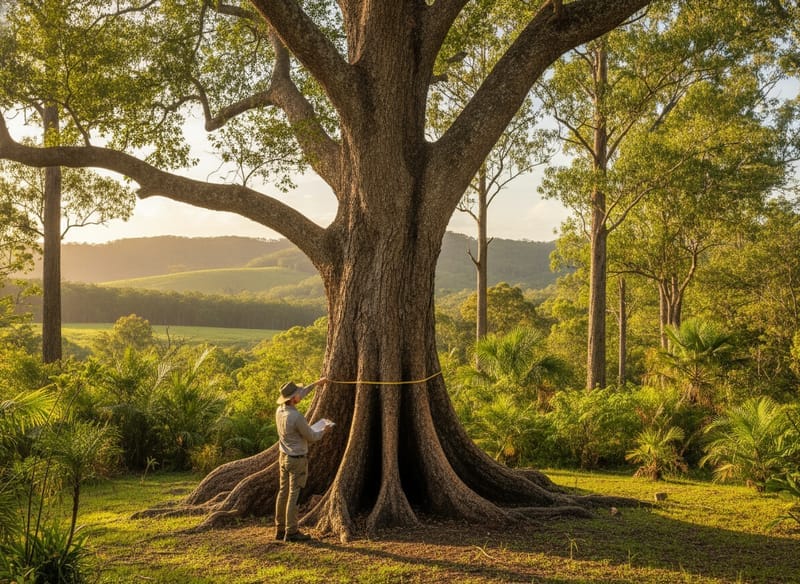
Our AQF Level 5 arborist measures trunk diameter (DBH), height, canopy spread, and checks for structural defects.
We calculate Tree Protection Zones (TPZ), structural root zones (SRZ), and assign health and retention values.
We draft a comprehensive written report complete with high-resolution photos, CAD mapping, and recommendations.
We provide final PDF documentation ready to lodge directly with council, builders, or your insurer.
Whether you are planning a new build on acreage, disputing a hazard tree on a boundary, or submitting a Development Application, securing an accurate Arborist Report Port Curtis is the essential first step. Port Curtis sits squarely on the Fitzroy River flood plain, boasting expansive blocks shadowed by mature Forest Red Gums, Leichhardt Trees, and sprawling Moreton Bay Figs. While these trees bring immense character, they also intersect tightly with Rockhampton Regional Council's planning overlays and state vegetation mapping.
Our AQF Level 5 consulting arborists deliver authoritative, council-ready reporting tailored to this distinct dry-tropics environment. We bridge the gap between your property goals and local compliance requirements, providing clear, legally robust documentation. From assessing flood-compromised root systems after the recent ex-Tropical Cyclone Koji inundation to drafting AS4970-compliant tree protection plans for builders, our team ensures your project moves forward without costly council pushback or environmental red tape.
The most common, and costly, mistake property owners make in Port Curtis is relying on under-qualified tree workers for formal documentation. A standard AQF Level 3 climbing arborist is highly skilled with a chainsaw, but they are not legally authorised to write formal reports for a Development Application (DA). When a builder or homeowner submits an uncertified assessment, Rockhampton Regional Council will simply reject it, delaying your project by weeks and forcing you to pay for a second, proper report.
Worse still, ignoring the requirement for an arborist report altogether can lead to severe penalties. Clearing native canopy inside a mapped Biodiversity areas overlay without a Tree and Vegetation Approval, or breaching the Vegetation Management Act 1999 on larger semi-rural lots, attracts heavy financial fines and legal action.
Our solution is straightforward. We deploy an AQF Level 5 consulting arborist to your Port Curtis site to conduct a rigorous, objective assessment. We map Structural Root Zones (SRZ), perform Visual Tree Assessments (VTA), and calculate Safe Useful Life Expectancy (SULE) ratings. Because we understand both the science of tree health and the strict frameworks of the Rockhampton Region Planning Scheme, our reports provide clear, scientifically backed justifications that certifiers and council planners accept the first time.
Our AQF Level 5 consulting arborists deliver a range of specialised reports designed to meet state and local requirements with precision and authority.
Comprehensive mapping of site vegetation required by Rockhampton Regional Council for new builds or subdivisions. Includes species identification, Diameter at Breast Height (DBH) measurements, condition ratings, and retention values to streamline your DA process.
Detailed strategies to safeguard retained trees during construction. We specify Tree Protection Zones (TPZ), protective fencing layouts, root mapping, and ground protection measures to prevent heavy machinery from compacting the soil on your site.
Utilising industry-standard Visual Tree Assessment (VTA) methodology to evaluate structural defects, disease, and decay. We calculate the likelihood of failure and potential impact on targets (homes, sheds, driveways), providing documented duty-of-care evidence.
When a protected tree is dead, dying, or posing an unacceptable hazard, we supply the formal diagnostic evidence required to secure a council removal permit. We detail the structural flaws and explain why pruning or retention is no longer viable.
Securing a formal arborist assessment with our team is a streamlined, transparent process designed to keep your project on schedule. Step 1: Initial Consultation and Scoping We start by discussing the specific trigger for your report. Whether it is a council request for further information on a DA, a neighbour dispute over a leaning Moreton Bay Ash, or a pre-purchase property inspection in Port Curtis, we tailor our site visit to address the exact legal or planning requirement. Step 2: On-Site Data Collection Our AQF Level 5 arborist arrives at your property to conduct the physical inspection. We measure trunk diameters, map canopy spreads, test soil conditions, and photograph structural defects. We use advanced diagnostic tools to identify decay that is not visible to the naked eye. Step 3: Overlay and Compliance Review Back at the office, we cross-reference our field data with RockePlan mapping. We check for Biodiversity areas overlays, flood constraints, and state vegetation protections to ensure all recommendations align with current Rockhampton Regional Council frameworks. Step 4: Formal Documentation and Delivery We draft a comprehensive, highly detailed PDF report featuring site maps, high-resolution photography, and definitive recommendations. Once signed off by our consulting arborist, the document is ready for submission to your certifier, council planner, or insurer.
Every arborist report we produce is drafted by a qualified AQF Level 5 consulting arborist, which is the mandatory credential required by Rockhampton Regional Council for formal planning submissions.
Our reporting strictly adheres to AS4970 (Protection of Trees on Development Sites) and AS4373 (Pruning of Amenity Trees). This ensures that any recommendations for retention, protection, or pruning are backed by national arboricultural standards. Furthermore, our consulting services are fully backed by robust Professional Indemnity and Public Liability insurance, giving builders, developers, and homeowners complete financial and legal peace of mind when acting on our professional advice.
Port Curtis presents a highly specific environment for tree management. Positioned on the Fitzroy River flood plain, properties here alternate between long periods of dry-tropics heat and sudden, severe inundation. The recent flooding following ex-Tropical Cyclone Koji in January 2026 left many mature trees with saturated root plates, leading to delayed structural failures and soil subsidence.
An Arborist Report Port Curtis must account for these exact conditions. When we assess a towering Forest Red Gum or a heavy-canopied Rain Tree on a low-lying block, we look specifically for signs of root rot, waterlogging stress, and storm-induced canopy fractures.
Additionally, many semi-rural blocks in Port Curtis are subject to the Biodiversity areas overlay under the Rockhampton Region Planning Scheme. Our local knowledge ensures we accurately identify native species versus declared weed trees, leveraging local planning rules to provide clear, actionable advice on what can be safely removed and what must be fiercely protected.
Once you receive your finalised PDF report, the next steps depend on your project. For development sites, you will need to hand the document directly to your private certifier or town planner to include in your DA submission. If our report mandates a Tree Protection Plan, you must install the specified AS4970 exclusion fencing and root protection measures before any earthmoving machinery enters the site. If the report justifies a hazard removal or structural pruning, you can book our AQF Level 3 climbing arborists to execute the physical work. We seamlessly transition from the consulting phase to the physical tree work, ensuring all cuts comply with the exact specifications outlined in our assessment.
Arborist report fees in Port Curtis reflect the number of trees assessed, the depth of diagnostic testing, and the purpose of the report.
We provide fixed-price quotes for all consulting arborist reports with guaranteed turnaround windows.
We provide AQF Level 5 consulting arborist reports across Port Curtis and the Rockhampton region:
Speak directly with our consulting arborists for development, risk, and council reports.
Request an Arborist Report